California DUI Lawyer Lawrence Taylor’s Speech
The following lecture, given to a group of business people in Washington State several years ago, is ADAPTED (with some minor editing) from the web site of the “Dean of DUI Defense”, Lawrence Taylor of Long Beach, California. It is reprinted here with Larry’s express permission.
I hope to convince you in the next hour, some of you, convince some of you, in the next hour that the greatest single threat to our freedoms, the freedoms set forth in our Bill of Rights to our Constitution. The single greatest threat is not from China. I don’t think it’s from Afghanistan. I don’t think it’s from the extremists of the Muslim world. The threat as it has always been throughout history is internal. It is from within. I do not think it is from the American Communist party or extremists on the right. I hope to convince a few of you the greatest single threat to our freedoms today is a group of American housewives. They call themselves the Mothers Against Drunk Driving, MADD.
I am fully aware that some of you belong to MADD. And I am certainly not here to make fun. Many of you who are in MADD are–have had tragic losses at the hands of drunk drivers. Others of you here do not belong to MADD, but you have contributed to MADD and many more of you here, perhaps most of you here, are in complete sympathy with their goals and their activities. But I hope to convince you after one hour that you might want to reassess your view of that particular organization.
And I do not take them lightly in terms of their intentions. But we know that throughout history it is the well-intentioned zealots–those who believe strongly in the rightness of their cause–that are most willing to impose those ideas upon others. I do not, by the way, for a moment suggest that we should legalize drunk driving. I’m going to make that clear at the outset. But it is the true believer who is the greatest threat. And I should at the outset acknowledge my tremendous debt to Mr. Eric Hoffer who wrote the book, “The True Believer.” He was a longshoreman when I was going to school at Berkeley in the 60’s. He did not have a high school education, but was teaching Philosophy at the University of California Berkeley and wrote this tremendous little jewel of a book that has been terribly influential in my own thinking.
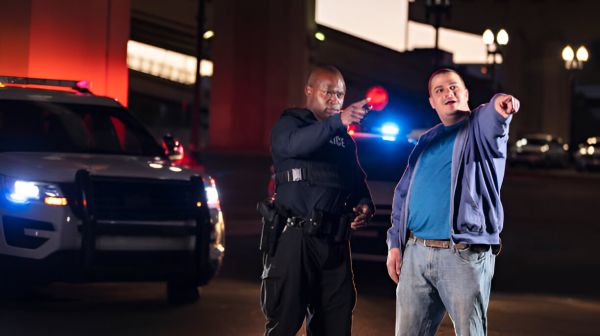
I would like you to imagine for a moment that you’ve gone to a friend’s house for dinner. In the course of a very good dinner you’ve had a couple of glasses of a good Shiraz and it is now time to drive home. I would like you to imagine that you are on your way home–and, I will tell you parenthetically, by the way, that two glasses of wine will not, in any state, put you under the influence of alcohol or over the legal limit of .08, or .10 depending on your home state. As you are driving along the highway, you see ahead of you some flashing lights and barricades and police cars accordioned across the highway, with flashing lights directing you into an increasingly small channel. And, as you go in, you are stopped and two police officers approach you and stick a flashlight in your face and say, “Breath on me. Have you been drinking tonight? Please step out of the car.”
Some of you say, “Well that can’t happen in the United States. We have the Fourth Amendment to the Constitution, which says, ‘Police officers have to have probable cause to stop you. They have to have a reason to believe you’ve done something criminal before they can stop and detain you.’” And so said the Michigan Supreme Court in the case of Sitz versus Michigan. The Supreme Court of Michigan said, “The Fourth Amendment does not permit these types of roadblocks.” And reversed the DUI conviction. They went up to the United States Supreme Court, unfortunately, and that august body decided 5 to 4 that somewhere in the Constitution there is something called a DUI Exception. And in a 5 to 4 vote sent it back to Michigan saying there is no violation here. What’s interesting is the Michigan Supreme Court; bless them, for there are fewer and fewer of them, said, “Well, if you will not protect our citizens in the state of Michigan from this kind of police conduct, we will. And we again reverse the conviction and this time we rely upon our own state constitution.”
The state of Washington and three other states have followed suit. In 46 states today it is legal to stop you for absolutely no reason other than the fact that you are driving a car. The only purpose is to check you out for drunk driving.
You have been stopped, you have been taken out of the car and you have been handcuffed. You are placed in a police vehicle and you are on your way back to the police station. About this time you’re probably wondering–I’ve seen this TV show somewhere–they’re supposed to read me something aren’t they? Something called Miranda? Aren’t I supposed to have a right for an attorney? Don’t I have the right to remain silent? That becomes an issue because, as you’re being driven to jail, the officer’s asking you all kinds of questions. Like, “Where have you been?” “Where are you coming from?” “How much have you had to drink?” “How long ago was it?” “When was the last drink?” “Do you feel the effects?” “Where are you now?” “What time of day is it?”
Well, again, a state Supreme Court said, “Hey, this person’s handcuffed and under arrest, you’ve got to advise him of his constitutional rights under Miranda.” And again, it went to the United States Supreme Court in the case of Berkemer vs. McCarty in 1984. The Michigan vs. Sitz case was 1990, by the way. In Berkemer vs. McCarty, the United States Supreme Court fooled around for about 20 or 30 pages of opinion and finally concluded that there was a DUI exception to the constitution. And that, “Well, we really can’t tell you when you’re supposed to give Miranda in a DUI case. We do know that it is later than in other types of criminal investigations.” So, the U.S. Supreme Court has told us we don’t know when Miranda is supposed to be given in DUI cases, but it is clearly some time later.
Well, about this time you arrive at the police station and the officer takes you into a room and there is this little metal box about the size of an IBM typewriter. Some of you may remember those. And he says breathe in here. And you say, “Wait a minute, I have a right to an attorney. Can I make a phone call?” “No”, says the officer. And, he’s right. However, this denial of access to an attorney is only applicable in DUI cases. He’s right. You’re about to give the most incriminating evidence possible to give in a DUI case and you have no right to seek the advice of an attorney as to whether to breathe into that machine or to agree to submit to a urine or a blood test, in the alternative.
And I’m only touching on a few of the problems. In California, for example, and in many other states, the law says you have a right to choose between breath, blood and urine. It is your choice. We have discovered in California, however, through our own Supreme Court that when the officer doesn’t give you that choice–just makes you breathe into that little black box–that’s okay. They’re not supposed to do it, but there’s no remedy. There’s nothing that can be done about it, so says the California Supreme Court. You can’t suppress the evidence. Police are not stupid, so now about half of them simply don’t give you that choice, since nothing’s going to happen if they don’t. So, you find out that you have no right to consult with an attorney.
Your next thought is, “I don’t know if I trust that little machine. Maybe I should refuse to breathe into it. I think I’m okay because, because as I remember, there’s a Fifth Amendment right in the United States Constitution that I don’t have to incriminate myself, and, not only that, but if it goes to trial, the prosecutor cannot even refer to the fact that I’ve exercised my Fifth Amendment right.”
The South Dakota Supreme Court, in Neville vs. South Dakota agreed a few years ago and they said, “This gentleman refused to incriminate himself by breathing into that machine and it was reversible error for the prosecutor to comment upon that to the jury and tell them that he refused, because he knew he was guilty.” Now you’re probably ahead of me, guessing the outcome here. It went to the United States Supreme Court. The United States Supreme Court, in South Dakota vs. Neville in 1983 said, “There’s a DUI exception to the Fifth Amendment. There is no right to refuse and the prosecution can comment freely in trial upon that refusal.” And they sent it back to South Dakota. And South Dakota said, “If you in Washington, DC will not protect our citizens, we will rely upon our own state constitution,” and they reversed it again based upon the South Dakota constitution’s provisions against self-incrimination. Unfortunately, that’s the last story I have of the State Supreme Court exercising protections of its own citizens.
So, you decide you’re going to breathe into that machine. And you do. You breathe into one end and out comes a piece of paper at the other end that says your blood alcohol concentration is 0.13. Now, at this point, in most states, the police are supposed to give you a choice as to whether you want urine or blood saved as well, so that you have something for your defense attorney to examine with an independent analysis rather than rely upon a crime lab of that very same law enforcement agency.
This is called the Trombetta Advisement. They don’t give it usually. They’re supposed to, but if they don’t, no harm, no foul and so it is rarely done. It’s called the Trombetta Advisement because a few years ago, in 1984, a defendant in California said, “Wait a minute, that machine captured my breath and minutes after analyzing it, just purged it into the room air. It could have saved the breath. (Very easy to do. Costs about $1.50 per sample utilizing a special kit to just preserve it.) It could have saved the breath and then my attorney could have had it analyzed by a separate laboratory by a more exact and reliable testing method. You have destroyed evidence that I could have analyzed and may have been exculpatory.”
This went to the United States Supreme Court and in 1984 in the landmark case of Trombetta vs. California, the Supreme Court found yet another DUI exception to the Constitution and said “Well, it would be nice if they saved the breath, but there’s no obligation to do so. And, destruction of that evidence, unless you can prove that it would have been exculpatory, has no impact.” So, today it is all right to destroy the evidence after you get your own results and make sure the defense doesn’t get access to it.
Finally, you’re rather outraged because you know you’re not under the influence. You know you’re not over .08, which is the California standard and the standard in about a third of the states today. And in 5 years will be the standard in all of your states because the federal government is telling you that’s what it’s going to be. And the Mothers Against Drunk Driving are ensuring that happens.
You decide to go find one of these people completely without any social value and ask them to represent you in trial. You want to tell a jury of 12 of your peers what happened. You want to give your version. So you tell your attorney, “I want a jury trial.” Your attorney says, “I am really sorry, but you can’t have one. You see we don’t have jury trials for DUI cases in this state, because in 1989 the United States Supreme Court in Blanton versus North Las Vegas, a DUI case, said, “There is no Constitutional right to a jury trial in a DUI case, so long as it’s not punishable by more than six months in jail.”
So, in several states today, including Nevada, Louisiana, New Jersey and Hawaii you have no right to a jury trial. And the Mothers Against Drunk Driving and a few other organizations are doing everything they can to make sure there are no jury trial rights in other states as well.
All right, we’ve taken a look at what happens to you as you go through the process in terms of any Constitutional rights you thought you had. And if you’d been charged with burglary, murder, rape, you would have had those rights. At least for now, until THOSE rights are taken away, utilizing the same necessity argument used for DUI prosecutions.
Now, let’s take a look at what the crime or DUI really is. What is the offense you just committed? I will tell you, that when I have clients come in the door, almost none of them know what the crime is, and probably half of them don’t know if they’re guilty or not.
In the beginning there was a law. That law said thou shalt not drive under the influence of alcohol. Period. It was a good law. We need it. It addressed the problem. It was fair. Unfortunately, there were some defendants being acquitted, after they sought trial with a skilled trial attorney. And so an inventor came along and said, “Well, I’ve got this super neat little gizmo here. I will call it the Breathomatic. It’s a box and if you breathe in this end, out the other end comes this piece of paper and it’ll tell you exactly how much alcohol is in the person’s blood, which is telling you about impairment of the brain.”
Well, that sounded pretty cool. And so legislators and prosecutors and MADD approached the American Medical Association and said, “We’ve got this great machine. Can you tell us at what level of alcohol concentration a person is impaired in their ability to drive a vehicle?” And the AMA said, “After extensive research it is 0.15 grams percent.” This was about 30 years ago… 0.15 percent.
Well, that was okay for a while, but a whole lot of people STILL were not getting convicted. Part of the problem was there was only a presumption that you were under the influence. In other words, the jury could accept if you were over a .15 that you were under the influence, or they could reject it and say other evidence shows that he wasn’t under the influence. Second problem is that a lot of people were coming in at 0.13, 0.14, and 0.12. Third problem is, you were 0.15 at the time of the test in the station, but what were you an hour earlier when you were driving?
So, those organizations went back to the AMA a few years later and said, “Are you sure about that 0.15. Couldn’t it really be a little lower?” And the AMA said, “You know, you’re right. It’s a 0.10.” Now, the human body, to my knowledge, had not changed in those 20 years, but certainly the American Medical Association’s research did. And replied to considerable political pressure. So, now jurors were told that they could presume guilt if there was a .10%. A dramatic change in the number.
Unfortunately, there were still skilled criminal defense lawyers out there and there were still acquittals, and the Mothers Against Drunk Driving, a very effective, very well financed organization, as some of you here know, was very successful by working through a federal agency called National Highway Traffic Safety Administration in putting pressure on states to FURTHER drop it to .08%. And I indicated earlier, about a third of the states have done exactly that, the others are following suit.
Well, there’s no question, there are fewer acquittals now and the prosecutors were increasing their conviction rate. But, there were still some acquittals. And so MADD and the other federal agencies decided to change the law further. More accurately, MADD came up with another law. This is called the per se law. If we can’t convince jurors that a person is under the influence over .08 we can make it a crime to merely drive while having a BAC over .08. The crime is being over .08 per se. We don’t care if they’re intoxicated or impaired. If the person has a BAC level over .08%, or .10% blood-alcohol perhaps, in your state; that is a crime. Not only that, let’s keep the original law. So, now we give the prosecutors two shots to obtain a conviction whenever a test is taken by a suspect. If they can’t convince the jury he’s under the influence, well then maybe they can convince them he was over .08, even though he was not under the influence and vice versa.
Well, this once again certainly increased the conviction rate, and the number of acquittals continued to drop. But there was a problem. Acquittals were still happening. New, creative and detailed attacks began challenging the technology involved in breath alcohol analysis. The gist of the attacks by criminal defense lawyers was based on the machine, to put it simplistically, assuming that you are an average person. Okay? It is measuring the breath. It is supposed to be measuring the alcohol in the vapor of the alveolar air in the deep lungs that you expel, and is analyzed in the machine. The machine is telling you how much alcohol is in the blood. Not in the breath. There is what we call a partition ratio. To put it simplistically, the machine has a very primitive Z80 computer inside it. There are different machines, but the computers will all report, “Well, if you’ve got this result from the breath, there must be 2100 times as much in the blood! Using a multiplier inside the little computer, that’s what it prints out.
But the computer is assuming that your partition ratio is 2100. Problem? Very few people have a partition ratio of 2100 to 1. It ranges anywhere from about 1100-to-one up to 3500-to-one and higher. And there is no way of knowing at the time of testing what your partition ratio was because medical studies have shown that the partition ratio changes within an individual all the time. One person is going to be very different than the person sitting next to him. Your partition ratio tomorrow is going to be different than what it is right now at this hour. Well, what does that mean? It means if you blow, let’s say, a 0.11 and you have a 1300-to-one partition ratio, that 0.11 is really 0.07. You’re innocent. Your crime, unfortunately, was not being average.
Well, a few defense attorneys were able to master the technology involved and attorneys usually go to law school because they failed physics, chemistry and so on in college. But, a few of these defense attorneys were actually learning how this machine worked. And they thought, “Whoa! There’s an assumption here, 2100-to-one,” and they cross-examined the expert from the law enforcement’s crime lab and said, “Isn’t it a fact?” And the guy would hem and haw and so on, and say, “Well, yeah.” Acquittal. The 2100 to 1 ratio issue is still a viable defense in a lot of states.
Not in California anymore. In California, our Supreme Court, which is slightly to the right of the U.S. Supreme Court, said, “No, not really because see what you’re doing is you’re measuring the alcohol on the breath. You’re not measuring the blood directly, you’re measuring on the breath, and therefore we don’t have to have a partition ratio.” Now, you probably don’t appreciate the complete idiocy of that statement, because the California Supreme Court did not understand the technology involved. And it was an eight-to-one decision. The dissenting justice said, Joyce Kenner had said, “Do you realize that we just created a new crime called driving with alcohol on your breath? And she was absolutely right. That’s what the Supreme Court of California did.
Result? If I now ask a law enforcement crime lab expert on the stand in front of a jury, “Isn’t it a fact that the partition ratio you used assumes an average of 2100-to-one?” I will be held in contempt of court and jailed by the judge. If I try to bring out the truth, I will be jailed as a criminal defense attorney. I’m not exaggerating. And I’m telling you that this is true in approximately four other states. I have lectured in 36 states to lawyers’ groups, bar associations, and so on, so I’m somewhat familiar with the different states and their different approaches. All of which are becoming much more standardized as the Federal Government continues to step in.
Well, that made things a lot easier for prosecutors to convict in California. Again, the conviction rate continued to go up. It became more and more difficult to defend people accused of drunk driving. I did not say “guilty”. Accused of drunk driving. Well, but there’s still lots of defenses left, because, as I will I hope I will have time to get into, this machine is, to say the least, unreliable. But one of the problems is called retrograde extrapolation. And I alluded to it earlier.
And that is, well it’s all well and good, he was a 0.11 at the time that he breathed into the machine at the police station. But it’s not against the law to be over a 0.08 in a police station. It’s against the law to drive a car over 0 .08. What was it at the time he was driving?
Well, that caused prosecutors a lot of problems. And so most states, almost all states, passed a new law with the assistance of the Mothers Against Drunk Driving. And that law said, “Any test within three hours that results in a blood alcohol reading, it shall be presumed that it was the same at the time of driving.” Even though we know absolutely, as a matter of science, fact, that that is not true.
Well, that again raised the conviction rate, except it was a rebuttable presumption. In other words, you could introduce evidence that that simply wasn’t true. And so now, to make a depressingly long story short, some states are beginning to pass laws saying that the crime is having over .08 at the time you breathe into the machine. And they don’t care what you were when you were driving the car. Notice how we’ve gotten further and further and further away from the evil we were trying to cure. And that is: “Were you impaired by alcohol when you were driving your car?”
Okay. Let’s take a look at this machine. The vast majority–in most states there is no urine test, and if there is a blood test, you’re usually not going to have access to it for later, independent analysis. In the vast majority of cases, because it’s cheap, easy and fast, you’re going to be breathing into one of these machines. Let me just give you a real quick rundown on breath test device theory. Incidentally, the book I wrote on Drunk Driving is about 1,200 pages in length, of which nearly 400 pages are just on the technology of breath machines, so this is going to be very cursory. But, I think, for purposes of illustrating some of the problems, it will help.
Basically just taking, as I said, the alveolar air, injecting it through a tube into a sample chamber and capturing it in that chamber. It’s a little 81 cc tube. Nickel-plated in most of the machines. And, by the way, there are a lot of different manufacturers of these different machines, different types, but we’ll get into that in a moment. These machines rust and corrode inside. The sample chamber gets pitted, it absorbs or retains in these pockets alcohol from previous subjects, and so on. But let’s just say for purposes of theory it captures a sample, a given volume of lung air, alveolar air. At one end it has a projector that projects infrared energy, infrared light, a beam through the chamber. The light passes through your breath that is passing through that little chamber. Now, at the other end of the chamber is a detector that receives the light from the other side. It then measures how much of this infrared energy gets ABSORBED and does not reach the other side of the chamber, where the detector is located. It measures this DIMUNITION of light by comparing the original intensity of the light to the diminished intensity of the light, multiples it by 2100, and spits out a number.
Now the theory of infrared spectroscopy, as applied to DUI cases, states that there is a part of a compound called the methyl group and that any compound containing the methyl group, will absorb the energy from this light wave that is traveling at 3.61 microns. The theory further holds that one of those compounds is ethanol, ethyl alcohol. Molecules of ethyl alcohol contain the methyl group as part of its structure. It is resonant with this particular frequency of light wave. So, the more ethyl alcohol in the sample chamber, the more energy is going to be absorbed, the less will get through to the receptor, the higher the blood-alcohol reading will go. Actually, the CONCEPT is fairly simple. Except, again, it is absorbed not only by ethyl alcohol, but also by the methyl group in any similar compound. In other words, it is a stupid machine. It does not differentiate between ethyl alcohol and any other compound. It is what we call “non-specific” for ethanol. Any compound on your breath that contains the methyl group will be detected as alcohol, and reported as alcohol. If you happen to have 32 different compounds containing the methyl group on your breath, it not only will report them all as alcohol, it is cumulative. It will add all of those, including any ethyl alcohol, and then report it in a number as ethanol.
So, do any of these methyl groups exist in the human breath? There are a number of scientific studies–one of which indicates that there are 102 different compounds found in the human breath that can contain the methyl group. So what you are getting is not necessarily alcohol. What you are getting is some unknown cumulative reading of any of these compounds on your breath. If you had been painting a house yesterday, today you would be registering alcohol on our breath machine. If you had been using solvents, or thinners or glue or anything like this, same result. If you had pumped gasoline into your car and inhaled any of the fumes, hours, even days later, you could be breathing out vapors containing compounds with the methyl group in it.
Now the second major problem I’ve already mentioned or alluded to, and that is the partition ratio. It is becoming less of a problem as the legal system chooses to pass laws or make rulings that outlaw, essentially, science.
A third, and this is just the last example I will give you, is called the mouth alcohol phenomenon. The machine assumes that the alcohol, or whatever it is measuring comes from your breath, and that’s why it’s multiplying by 2100. Obviously, if it is getting alcohol directly from your stomach or your throat or your mouth, it’s going to fool the machine and the results are going to go extremely high. It would take a minuscule amount of alcohol in your mouth, throat or stomach to fool the machine and create a pretty high BAC reading. This is called the trapped alcohol or mouth alcohol problem. So, if for example, you burp or belch, and any gases from your stomach, or you have reflux condition, or a hiatal hernia, and any of those gases or liquids come up your esophagus, and remnants of the saturated gas will stay there for about 15 to 20 minutes before saliva dissipates it. It will be breathed into the machine, if you are being tested. The machine will report an unknown amount, which will be falsely high. It does not mean you’re under the influence. It does not mean you’re REALLY a 0.08. It’s simply that you had alcohol in your mouth, your throat or your stomach. The police officers are supposed to guard against this by observing you for 20 minutes. They are supposed to sit down and watch you for 20 minutes before giving the test. In all the years that I have been defending, or for that matter prosecuting, DUIs, I don’t think I’ve ever encountered an officer who actually did that. They are far too busy to fool around with things like that. They will check the box, and SAY they did, but it does not happen and I’m not sure they could even tell if a belch DID happen. The 20-minute OBSERVATION period is a safeguard, but one that the police ignore.
So, these are just three examples. There are hundreds of things wrong with these machines, not just theoretically, but applied to the machines themselves. How accurate are they? They’re accurate–they’re close enough for government work. In California, for example, the standards of accuracy—by law—are that you MUST have duplicate analysis (two sequential tests) and each result must be within 0.02% of the other. That means you’d have to take two tests. If the first one, just to use a number to make it mathematically easy, if the first one is 0.10%, the next one has to be 0.08, 0.09, 0.10, 0.11 or 0.12. Think about it: a 40% range of error is scientifically accurate in a case where the State must prove your guilt beyond a reasonable doubt. In most states, a 40% range of error is considered to be acceptable accuracy. Good enough for GOVERNMENT work.
The people that make these machines—and I have never referred to them as instruments— the people that make these machines keep coming out with new models. They’ll come out with a model and call it state-of-the-art, foolproof, fail-safe, and then two years later they come out with a new model that takes care of all of the problems found to have existed with the first model. Meanwhile 100,000 people have been tested on the old device (which is quietly retired from service), yet none of those convicted can re-open their guilty pleas, or undo the damage done to their lives and careers by the MACHINE. Then a competing breath manufacturing company comes out with a new and improved model that takes care of the problems with their competitor’s new model. And this is a fairly regular battle of the manufacturers, year after year.
If you look at the warranties—it is sort of interesting—none of the breath machine manufacturers warrant these things to actually test blood alcohol. If you read the warranties, there is no warranty for fitness for a particular purpose. That’s a legal phrase. Basically it means they don’t want to get sued by somebody if there is a false reading. So they will not even warrant these things to do what they’re selling them to do. The standard warranty, for a total breakdown of the device, is about one year–about what your toaster is warranted for. Similar warranty periods. The difference between the two machines? Your toaster is warranted to toast bread.
Okay. Science and law. Right off the bat we’ve got a problem. Science, if you can define it, would be, I would say, the systematic pursuit of truth. The objectives of law are very different. It is a governmental mechanism for imposing order, structure, predictability, security, and confidence of the public in its institutions. The law is not concerned with truth. It is important to understand the entire DUI field.
To understand it you must understand the difference. Hundreds of years ago a guy named Galileo said, the universe is really not FLAT, the way the Vatican says it is. You saw what happened to Galileo. The government, for saying such things, based on SCIENCE, executed him. Have we progressed? Not if a lawyer tries to tell the truth to a jury about the LIMITATIONS of a breath machine, and, in doing so, is thrown in jail for properly and zealously representing his/her client. I would say we have not come all that far since Galileo’s days.
Now lastly, as to what you’re looking at as you imagine going through these different procedures, I would just very briefly, as to punishment, rather than going through all the horrors of DUI punishment today, complexities of punishment today, other than to say in California you’re better off as a first offense burglar or for committing felony grand theft than you are as a first time misdemeanor DUI offender. At least as a felon, you can request first offender treatment, or possibly conditional discharge for some fairly serious crimes, but such a record-clearing solution is UNAVAILABLE for all DUI offenders.
In closing, I will comment on two things. The Mothers Against Drunk Driving have been very active recently in trying to get “Scarlet Letter” laws passed. They almost did it two months ago in California. Came close. The Scarlet Letter law is: if you are convicted of a DUI, you must have a big bright red license plate saying the big scarlet letter DUI on it. Your wife has to drive it. Your kids have to drive it. You would not be able to rent a car, whatsoever, because the tag would be lacking your badge of dishonor. You must carry that brand on you, says MADD. It must remain with you for as long as you drive a car for whatever period of time. It did not pass last time. But, as MADD knows, there is NEXT YEAR.
The other comment is about a case many of you may have heard about in North Carolina. Now, we have never executed people, we’ve never, until recently, given the death penalty for a crime unless there was pre-meditation of the offender. Intention to kill and time to reflect upon that and then to carry out the plan and cold-bloodedly murder. Some exceptions have been added: Killing a police officer; multiple murders; murder by torture; murder for ransom. In North Carolina this year there was a DUI case involving an accident. Another person died. It would, in any other case, in another state, likely be a vehicular manslaughter case. It was not an intentional act. It was negligent; it may have been reckless. And the prosecutor sought the death penalty. The death penalty. Fortunately, they didn’t get it. My understanding is that the defendant was convicted of MURDER and only received LIFE IN PRISON, but I don’t know.
So, in the DUI field you have unfair procedures. You have false evidence. You have wholesale erosion of rights. But, some may rationalize, at least the DUI-caused fatalities are falling correct? If you believe the statistics from the Mothers Against Drunk Driving and National Highway Traffic Safety Administration, that would be correct. If you look at it more closely, you’ll find they start using terms like “alcohol-involved”, “alcohol-related”, and those statistics start changing to justify what they have been doing for the last few years. The numbers have been gerrymandered so that if ANY person involved in ANY way in the accident had ANY alcohol in his/her system (even 0.01 per cent), MADD counts that (and our federal government counts that) as an alcohol-related death.
So, what is happening in the DUI field? Same thing that’s always been happening. The real danger to your lives, to my children and your children’s lives, are from recidivists. Statistically overwhelmingly, the risk lies with recidivists. People that have driven drunk repeatedly. Which is a relatively, despite what MADD says, a relatively small percentage of those who are arrested. Problem? How do you reach those people? Can you affect the incidence of death caused by DUIs by increasing the punishment? As to those recidivists, and I tell you–no.
You are trying to use the legal system to address what is at least a medical, perhaps psychological, but in my opinion, absolutely a genetic problem. Now that sounds like an easy cop-out for me. I wrote a book about 15 years ago called Born to Crime, The Genetic Causes of Criminal Behavior, so I suppose that I am a little bit biased, but I’m basing what I say upon defending thousands and prosecuting thousands of DUIs and I’m absolutely convinced that it is genetic in origin. And I think the studies, and one of the chapters of that book Born to Crime was devoted to alcoholism–the studies are overwhelming. If my own experiences with clients have not been, those studies certainly are. And so long as you have a system that is geared to behavioral modification–that is, we’re going to change his drinking habits by putting him in jail for six months, or deterrence: We’re going to stop other recidivists from driving drunk because of the deterrent effect, then you’re fooling yourselves.
Do I have an answer? No, I don’t. But I know that system isn’t working, and in the meantime you are destroying the Constitutional rights that we’ve all previously enjoyed. Since 1979, when Candy Lightner started MADD, those all-important rights have taken a blood bath.
Again, the legal system is not concerned with truth. And it may come as a shock, but it is not. It is concerned with order, stability. If the legal system were seeking truth, the government would not falsely assume that there’s a 2100 to 1 partition ratio. If the legal system cared about truth, they would not conclusively presume that your blood-alcohol was the same number three hours earlier, when the government knows it is not. If they sought truth, they would recognize that these machines are non-specific, among other problems. The legal system is not concerned with justice, either. It is concerned with expediency, not justice. If they were concerned with justice, they would not permit roadblocks. They would not presume guilt. They would not pass laws refuting scientific truth.
I just said, “They would not presume guilt.” That was another DUI exception to the constitution that I didn’t tell you about. One other thing the police officer does after he has you breathe into that machine, if you’re over .08, is that he immediately grabs your license and confiscates it. This is another contribution from MADD. Immediate seizure of the license in about 48 of the states today. On the spot. Justice administered by the police officer. No judge. No jury. You are presumed guilty. Your license is confiscated and you are given a notice of suspension. What happened to the presumption of innocence?
Well, it’s that DUI exception again. You are presumed guilty.
To make matters even worse, about 5 years ago a California proposition was placed on the ballot. The question: Should we, the people of California, eliminate our STATE constitutional rights, and only retain those constitutional rights REQUIRED to be kept by the United States Constitution? Amazingly, after a well-financed television campaign by ultra-right groups who found the Constitution to be a shield for criminals, the people of California voted to NOT HAVE ANY STATE CONSTITUTIONAL RIGHTS! For the first time in recorded human history a democratic group abandoned hard-earned rights and legal protections that their forefathers has sweated, bled and died to obtain.
Welcome to America! Welcome to the land of the free and the home of the brave.
More DUI Resources
We have informative articles on several different aspects of DUI law and DUI charges all across the country.
- Alcoholism
- Atlanta DUI Lawyer William C. Head
- Former U.S. Presidents and VPs With DUIs
- How to Hire A DUI-DWI Attorney
- 101 Ways to Avoid a Drunk Driving Conviction
- DUI Driver’s Rights Cards
- Five Myths About Defending Accused Drunk Drivers
- Find a DUI DWI OWI OUI Lawyer / Attorney (Drunk Driving) in YOUR State
- Constitutional Law
- Your Legal Rights